November 14th - 26th 2005
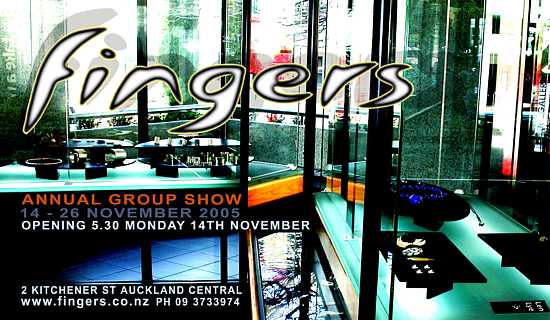
Fingers Annual Group Show
October 10th - 22nd 2005
Kobi Bosshard and Peter Mckay
September 19th - October 1st 2005
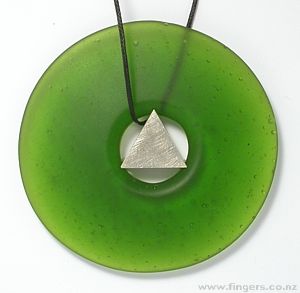
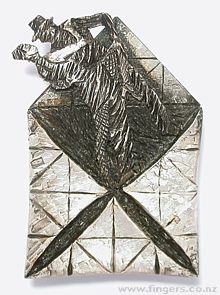
Fran Allison, Andrea Daly, Shelley Norton, Lisa Walker
Weeds

"I wonder why someone would choose to be a weed in the garden of jewellery. The answer seems to have something to do with a desire to intensify awareness of everyday things as things in them selves rather than as signs of something else. It is that experimental sensate thing to which Sontag points, the pleasure of touching the familiar and finding it strange, the pleasure found in the weedness of weeds."
Grant Thompson
August 8th - 27th 2005
Joanna Campbell
Swatches 2
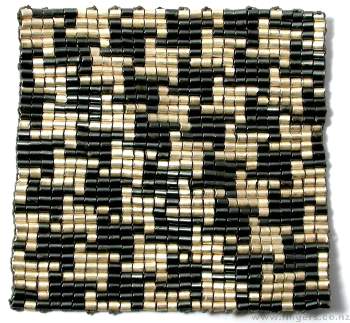
In 'Swatches 2' Joanna Campbell continues her process driven exploration of
textiles and metal. She investigates specific qualites of fabric such as drape, weight and bias and reinterprets them using gold and silk.
July 18th - 30th 2005
Karl Fritsch
blind diamonds and rough rubies
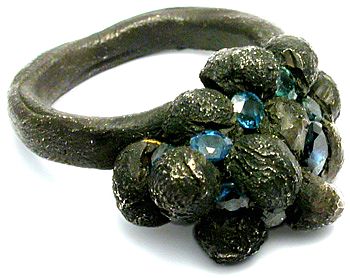
"In George Perec's novel A Void, which he wrote entirely without the letter 'e', there's a story about a ring. Perec compares it to a scab, because it has almost become part of the body with age and wear. Karl Fritsch's rings have that quality. It's like inverse alchemy. He uses precious materials and turns them into childish, rough objects that look like they've come out of a candy machine. They're so immediate you can see the fingerprints. A Karl Fritsch ring is like an heirloom, something your great-grandmother might have worn." Francis Upritchard
July 4th - 16th 2005
Brian Adam
Finger Rings

"These ring forms come from their process. I added bit of natural force,
pressure, heat, gravity and steam, to the material's own properties to shape the
objects." Brian Adam, 2005
June 7th - 18th 2005
Areta Wilkinson
Legere to gather

Brooch, Pohutukawa, Metrosideros excelsa, Christmas Tree
"Fabricated silver plants build on earlier investigations of colonisation and identity. Legere is Latin the language of taxonomy, Legere To Gather is a gathering of stimuli and the exhibition a celebration of process.
New works were developed from a range of visual and research sources relating to the botanical collecting on Cooks first 1769 voyage to New Zealand. They included original Banks and Solander plant specimens housed in Auckland Museum and Lincoln herbariums, Sydney Parkinson etchings, botanical photographs painting and drawings, my own pressed plant specimens and material experiments." Areta Wilkinson, 2005
Areta would like to acknowledge the support of Creative New Zealand.
May 16th - 28th 2005
Tania Patterson
Specimens

"This group of work continues my interest in New Zealand natural history and the overlaps between science and art. At Auckland Museum I came across some drawers filled with dead birds, I was struck by how little they told me about birds. These sad inanimate creatures spoke to me more of my own dead, yet these dead things do teach us about life. I am interested what the static museum display does and doesn't teach us." Tania Paterson, 2005
March 21st - April 2nd 2005
Andrea Daly
Drawing Angel Wings

"This is a whimsical body of work referencing the romantic angel figure. They inhabit the world of 'just out of sight' and though rarely seen they leave their traces everywhere through our literature, religions, myths and contemporary media. They represent potential and possibility, the magical promise of the unknown."Andrea Daly, 2005
February 14th - 26th, 2005
Pauline Bern
The Ring Project

"I have re-viewed my local environment as a resource, selecting from the beach worn fragments of Waitemata papa, weathered pohutukawa and man-made remnants for intervention and transformation, reassessing the banal.
Made from structures and materials susceptible to wear and tear the rings are as vulnerable as the relationships they so often represent. Care must be taken: unlike the timeless durability of the convention of gold and diamonds, these rings may act as a reminder of the fragility of our emotions and interactions." Pauline Bern, 2005
January 17th - 29th, 2005
Lynn Kelly
Exotic or Not?

Historically and even today the Pacific conveys the idea of the exotic to new comers. To recognize this view of ourselves and our surroundings is almost unimaginable. It is this possibility of seeing the familiar with an alien gaze that Kelly explores. She represents iconic botanical symbols of New Zealand in a variety of materials that demand a re-inspection of that which we take for granted.
Pennie Hunt writes, "Lynn Kelly's confident use of diverse materials explores the ways in which native plant species can appear delightfully strange, even to accustomed eyes. The real lure of these pieces is that each one has the ability to explore our botanical residents afresh, re-inventing and re-discovering what constitutes the native."
(Art New Zealand Summer 2004-2005, p47).
November 8 - 20, 2004
Fingers Annual Group Show

October 26 - November 6 2004
Sandra Bushby
'Cut outs'

"Since 2003 I have been making sculptural installations and brooches using domestic fabric and the handcraft of embroidery.
The brooches for this exhibition have been inspired by New Zealand hand made jewellery from the 1930's era. My approach is modernist cut out techniques and traditional embroidery methods. Using the scissors and fabric I have cut out positive/ negative geometric shapes and embedded found objects in to the fabric.
Materials used are found objects such as bakelite and glass haberdashery combined with felt, linen or towels. Random themes such as navigation have been developed as a direct result of meanings associated with a particular found object."
Sandra Bushby, 2004
October 4 - 16, 2004
JamFactory (Adelaide)
'Two Degrees South'
Adelaide and Auckland lie within two degrees latitude of one another, they share histories of nurturing and supporting contemporary jewellery workshops, jewellery collectives and galleries. Both cities have internationally renowned reputations for vibrant contemporary jewellery communities. Both cities have a growing pool of young practitioners. And both cities have their own style.
For over 30 years the JamFactory in Adelaide, South Australia has been running a professional training scheme, exhibition programme and two retail shops.
Housed in a purpose built complex in the heart of the city JamFactory has four studios, ceramics, furniture, hot glass and metal, two gallery spaces and an award winning retail facility.
The Metal Design Studio at JamFactory has been offering a Career Development Scheme and Artists in Residence program for over twelve years. Graduates from all around Australia and overseas compete for one of the five positions in the studio's Career Development Scheme, to spend two years working in the studio developing their own practice and learning new skills and techniques while working on a range of corporate commissions and architectural projects. The Career Development Scheme prepares young designer makers for a vibrant career in the arts through a busy and exciting mentoring program.
From a large pool of Metal Design Studio alumni seven artists have been selected to show their work in Auckland. The work of these artists cover a diverse range of conceptual and material approaches to jewellery making, while sharing a high level of skill and technical accomplishment.
Artists exhibiting in the 'Two Degrees South' at Fingers have been asked to respond to the themes of 'place' and 'identity' in relation to their work. In the show you will see brooches, bracelets and rings made of felt, upholstery fabric, resin, silver and steel.
Exciting approaches to ideas and often unusual materials all beautifully executed.
| 


